
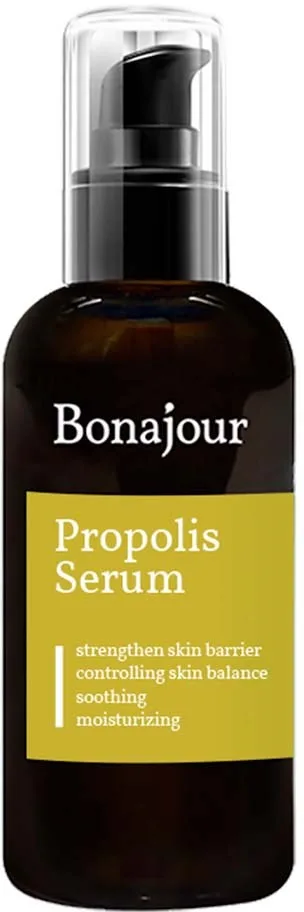
Bonajour
Propolis Serum
A antioxidant-rich serum by Bonajour — featuring Saccharomyces Ferment Filtrate (rich in amino acids, vitamins b,) and Laminaria Digitata Extract (fucoidan (sulfated…).
30 of 30 ingredients identified
Informational only — check the packaging and a professional for advice.
Barrier-support ingredients present
Bletilla Striata Root Extract help reinforce the skin barrier.
Contains fragrance
Fragrance is a common trigger for sensitivity and irritation in reactive skin.
Category breakdown
Antioxidant · 8Soothing · 7Active · 5Solvent / vehicle · 4Humectant · 2Barrier support · 1Fragrance · 1Other · 1Preservative · 1
Relationships
Works well together
Ulmus Campestris Bark Extract + GlycerinAngelica Dahurica Root Extract + GlycerinTrichosanthes Kirilowii Root Extract + GlycerinBroussonetia Kazinoki Root Extract + GlycerinEpigallocatechin Gallate + Green Tea Extract
Full ingredient breakdown
1
A bee-derived resin extract with soothing and antioxidant properties.
3
A gold-standard humectant that draws water into the skin.
5
A polyphenol-rich antioxidant that also calms skin.
6
Bark extract of white willow (Salix alba), containing salicin and anti-inflammatory polyphenols used to soothe, provide antioxidant protection, and support gentle skin renewal.
7
A filtrate from fermented Saccharomyces cerevisiae (brewer's yeast or sake yeast). Contains amino acids, B vitamins, peptides, and fermentation-produced bioactives. Used extensively in Japanese skincare (Elixir, Kiku-Masamune sake line) for skin conditioning and barrier support.
8
An extract from the leaves of Cryptomeria japonica (Japanese cedar) containing polyphenols and terpenes with anti-inflammatory and antimicrobial properties.
9
An extract from the leaves of the sacred lotus (Nelumbo nucifera), distinct from seed and flower extracts, rich in antioxidant alkaloids and flavonoids.
10
Plantago Asiatica Extract is derived from the leaves and whole plant of Asian plantain, a staple of East Asian herbal medicine. Its key actives — aucubin, plantaginin, and mucilage polysaccharides — deliver anti-inflammatory, wound-healing, and barrier-supportive effects. Widely used in K-beauty serums and toners as a calming agent for sensitized or compromised skin.
11
An extract from persimmon (Diospyros kaki) leaves rich in triterpenoids, tannins, and ursolic acid, used in K-beauty products for antioxidant, soothing, and mild brightening effects.
12
Ulmus Campestris Bark Extract (field elm, Ulmus minor) is an astringent and soothing botanical used in traditional European herbal medicine. The bark contains tannins, mucilaginous polysaccharides, and phytosterols — a combination that provides temporary pore-tightening, surface-calming, and mild barrier-reinforcing effects. Distinct from slippery elm (Ulmus rubra/fulva) and not interchangeable.
13
Laminaria Digitata Extract is derived from oarweed, a brown marine macroalga harvested primarily from the North Atlantic. It is exceptionally rich in fucoidan, alginates, iodine, minerals, and vitamins that collectively deliver hydrating, antioxidant, firming, and barrier-reinforcing benefits. Its multi-functional marine active profile makes it a premium ingredient in K-beauty anti-aging and hydrating formulations.
14
Gleditsia Australis Thorn Extract is sourced from the thorns of the honey locust tree (Gleditsia sinensis/australis), long used in traditional Korean and Chinese medicine as Zao Jiao Ci (皂角刺) for skin-clearing and anti-inflammatory purposes. The extract is rich in triterpenoid saponins, flavonoids, and alkaloids that contribute to its calming, clarifying, and sebum-modulating effects.
15
Angelica Dahurica Root Extract (Bai Zhi / 白芷) is derived from a root in the Apiaceae family deeply embedded in traditional Chinese and Korean medicine for brightening, anti-inflammatory, and antimicrobial activity. Its bioactives include coumarins, furanocoumarins, volatile oils, and polyacetylenes — the furanocoumarins (psoralen, bergapten) are photosensitizing agents that render standard extracts unsuitable for leave-on daytime use without confirmed furanocoumarin removal per SCCS limits.
16
Cimicifuga racemosa (black cohosh) root extract is derived from the rhizome of a plant native to eastern North America, used in Native American and Western herbal medicine. In cosmetics, its triterpene glycosides and phenolic acids deliver anti-inflammatory and antioxidant activity for calming sensitive or reactive skin. The hepatotoxicity concerns from oral supplementation do not apply to topical cosmetic formulations.
17
Bletilla striata (Bai Ji) is a terrestrial orchid native to East Asia whose dried tubers have been used for centuries in Traditional Chinese Medicine to stop bleeding and promote tissue healing. The root extract is valued in premium K-beauty formulations for its high polysaccharide content — primarily glucomannans — delivering both film-forming humectancy and meaningful barrier repair, supported by pharmacological research confirming fibroblast activity stimulation.
18
Extract from Oryza sativa (rice); provides ferulic acid, gamma-oryzanol, and saccharides for antioxidant protection and brightening. One of the foundational ingredients in K-beauty and J-beauty.
19
An extract derived from the seeds of Phaseolus radiatus (mung bean), used in cosmetics for its antioxidant and skin conditioning properties.
20
Trichosanthes kirilowii root extract (Tian Hua Fen) is derived from the starchy root of the Chinese snake gourd, used in TCM for its cooling and fluid-promoting properties. The cosmetic extract provides humectant moisture-binding and mild anti-inflammatory benefits from its polysaccharide and sterol fractions. Properly processed cosmetic extracts are not expected to retain biologically active trichosanthin.
21
Broussonetia kazinoki (paper mulberry) root extract is a cornerstone brightening ingredient in Korean beauty. Its distinctive prenylated flavonoids — particularly kazinol F and broussochalcone A — inhibit tyrosinase more potently than kojic acid in several comparative in vitro studies, making it highly effective for addressing melasma, PIH, and uneven skin tone. Widely used in K-beauty brightening serums and essences, often paired with niacinamide for complementary melanin inhibition mechanisms.
22
An extract of clove (Eugenia caryophyllus) flowers used in cosmetics for antioxidant and antimicrobial properties; distinct from the distilled essential oil, with a lower volatile eugenol content.
24
An extract from the fruit of the cranberry (Vaccinium macrocarpon) rich in proanthocyanidins, anthocyanins, and polyphenols that provides antioxidant and anti-inflammatory benefits to skin.
25
An extract from the lowbush blueberry (Vaccinium angustifolium) fruit rich in anthocyanins, flavonoids, and vitamin C that provides antioxidant protection and skin-soothing benefits.
30
Epigallocatechin-3-gallate (EGCG) is the dominant polyphenolic catechin in Camellia sinensis (green tea) and the most studied tea antioxidant. It exerts free-radical scavenging, MMP inhibition, and NF-κB/MAPK anti-inflammatory activity in skin. Used as an isolated active for targeted antioxidant and anti-photoaging effects at higher potency than whole green tea extract.