
Sulwhasoo
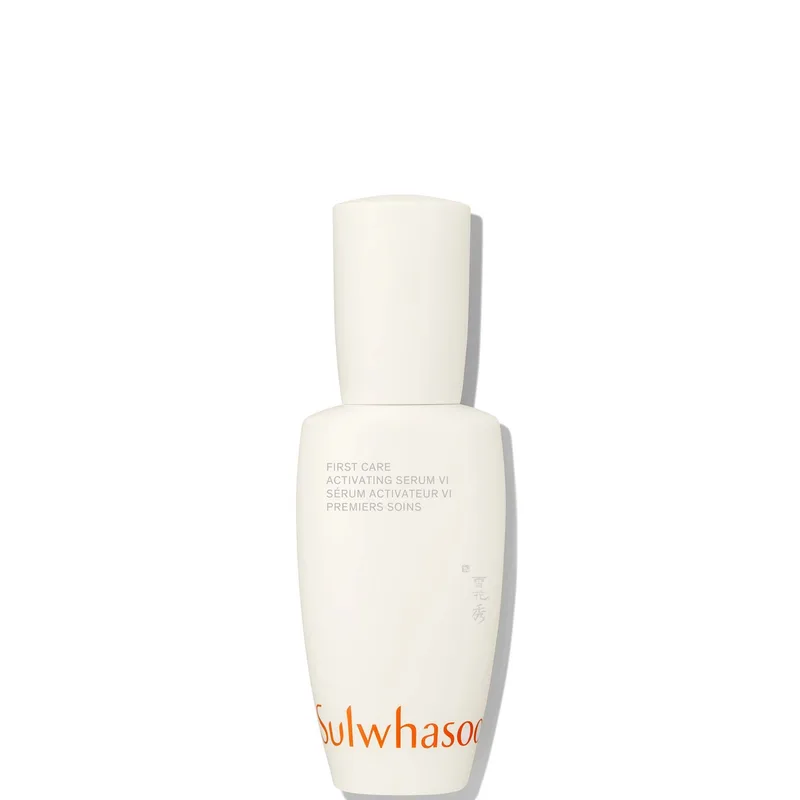
First Care Activating Serum VI
A hydrating serum by Sulwhasoo — featuring Adenosine (helps smooth fine lines) and 2-O-Ethyl Ascorbic Acid (stable vitamin c derivative…).
50 of 50 ingredients identified
Informational only — check the packaging and a professional for advice.
Actives combined with exfoliation
This formula pairs active ingredients with exfoliation. Introduce gradually and watch for sensitivity.
Contains fragrance
Fragrance is a common trigger for sensitivity and irritation in reactive skin.
Category breakdown
Other · 9Solvent / vehicle · 7Humectant · 7Antioxidant · 7Fragrance · 6Soothing · 6Emollient · 3Active · 2Surfactant · 1Preservative · 1Exfoliant · 1
Relationships
Full ingredient breakdown
4
A gentle humectant derived from sugar beets.
13
A skullcap root extract rich in baicalin flavonoids with potent antioxidant and soothing action.
16
A nucleoside used at low concentrations to help smooth the look of fine lines; a common K-beauty anti-aging active.
19
An extract of cocoa (Theobroma cacao) rich in polyphenols such as flavanols that provide antioxidant and soothing benefits; distinct from the seed-specific extract form.
25
A natural humectant that hydrates, soothes and conditions skin with mild antimicrobial activity.
26
An isolated active from centella with strong soothing effects.
27
An extract from the root of Rehmannia chinensis (Chinese foxglove), one of the 50 fundamental herbs in TCM. Contains iridoid glycosides, oligosaccharides, and amino acids used for skin conditioning and antioxidant support in Japanese prestige skincare.
29
A licorice-root-derived salt that calms inflammation and soothes irritated, reactive skin.
30
An ether derivative of L-ascorbic acid in which the 3-OH position is protected by an ethyl group, making it stable in water-based formulas. Converts to Vitamin C inside skin cells. Used widely in Japanese brightening products (Shiseido, Elixir) as a quasi-drug-adjacent brightening active.
31
A sulfonic amino acid that functions as a humectant and osmoprotectant, helping skin cells maintain hydration balance under osmotic stress.
32
An extract from the tuberous roots of Ophiopogon japonicus (lilyturf / Maidong), a classic TCM herb; rich in steroidal saponins and fructo-oligosaccharides that provide humectant, soothing, and skin-conditioning benefits.
33
An extract from the root of Paeonia lactiflora (herbaceous peony / Bai Shao), a distinct species from tree peony (P. suffruticosa) and white peony (P. albiflora), used in traditional Chinese and Korean medicine for its soothing, anti-inflammatory, and mild brightening properties.
34
An extract from the bulb of Lilium candidum (Madonna lily) containing polysaccharides and flavonoids, used to soothe and condition skin.
36
An extract from the rhizome of Polygonatum odoratum (scented Solomon's seal / angular Solomon's seal), a TCM botanical distinct from P. officinale; contains polysaccharides, steroidal saponins, and flavonoids with humectant and antioxidant properties.
37
A polysaccharide that binds to skin to provide lasting hydration and a soothing film.
39
A revered K-beauty botanical used for antioxidant, brightening and revitalizing effects.
40
Whole-plant extract from Nelumbo nucifera (sacred lotus); distinct INCI from flower- or root-specific extracts. Used in prestige hanbang formulas for its broad polyphenol profile.
41
Natto gum is polyglutamic acid (PGA) — a biopolymer produced by Bacillus subtilis during the fermentation of soybeans (natto). It has extraordinary water-holding capacity, exceeding even hyaluronic acid. Used in Matsuyama's Hadauru ceramide line for superior moisturization.
42
An extract from the fruit of Zizyphus jujuba (jujube / Chinese date). Contains cAMP, betulinic acid, and polysaccharides that provide soothing, antioxidant, and moisturising benefits in luxury Japanese and Chinese skincare.
43
An extract from the seeds (kernel) of Juglans regia (English walnut), rich in polyphenols including ellagitannins and juglone, used for antioxidant and skin-conditioning properties; potential sensitization from juglone should be noted.
44
An extract from the fruit of Prunus mume (ume / Japanese plum or apricot), a plant central to Japanese traditional beauty practices, valued for its antioxidant polyphenols and organic acids that contribute brightening and conditioning effects.
49
Vitamin E; a lipid-soluble antioxidant that also conditions skin.
50
An AHA most often used in small amounts to adjust pH.